MBTI PERSONALITY PROFILE · INFJ
The INFJ personality: understanding others without losing your voice
You connect the clues. You notice what is happening between people. Sometimes the question you most need to ask is the one you keep to yourself.
By Kyrian Hermansen · A function-based reading

Perhaps you’ve left a conversation with a clear impression, then spent the evening trying to explain it. A word, a pause, a detail connected to an earlier exchange. Sometimes your reading is accurate. Sometimes one straightforward question would have changed the whole story. That process is what I want to examine with you when we talk about INFJ.
What does INFJ mean?
INFJ stands for Introversion, Intuition, Feeling, and Judging in the MBTI framework. Feeling refers to a way of evaluating what matters, including in relationships; it does not measure how much emotion you experience. Introversion is not simply shyness, and J does not require a perfectly organized desk.
INFJ descriptions often emphasize rarity, exceptional intuition, or a gift for understanding people. Those claims can be flattering without helping you understand yourself. I’m more interested in how you form an interpretation, check it with the people involved, and express what you want. You can enjoy listening and still need boundaries. You can care about meaning and still misread an intention.
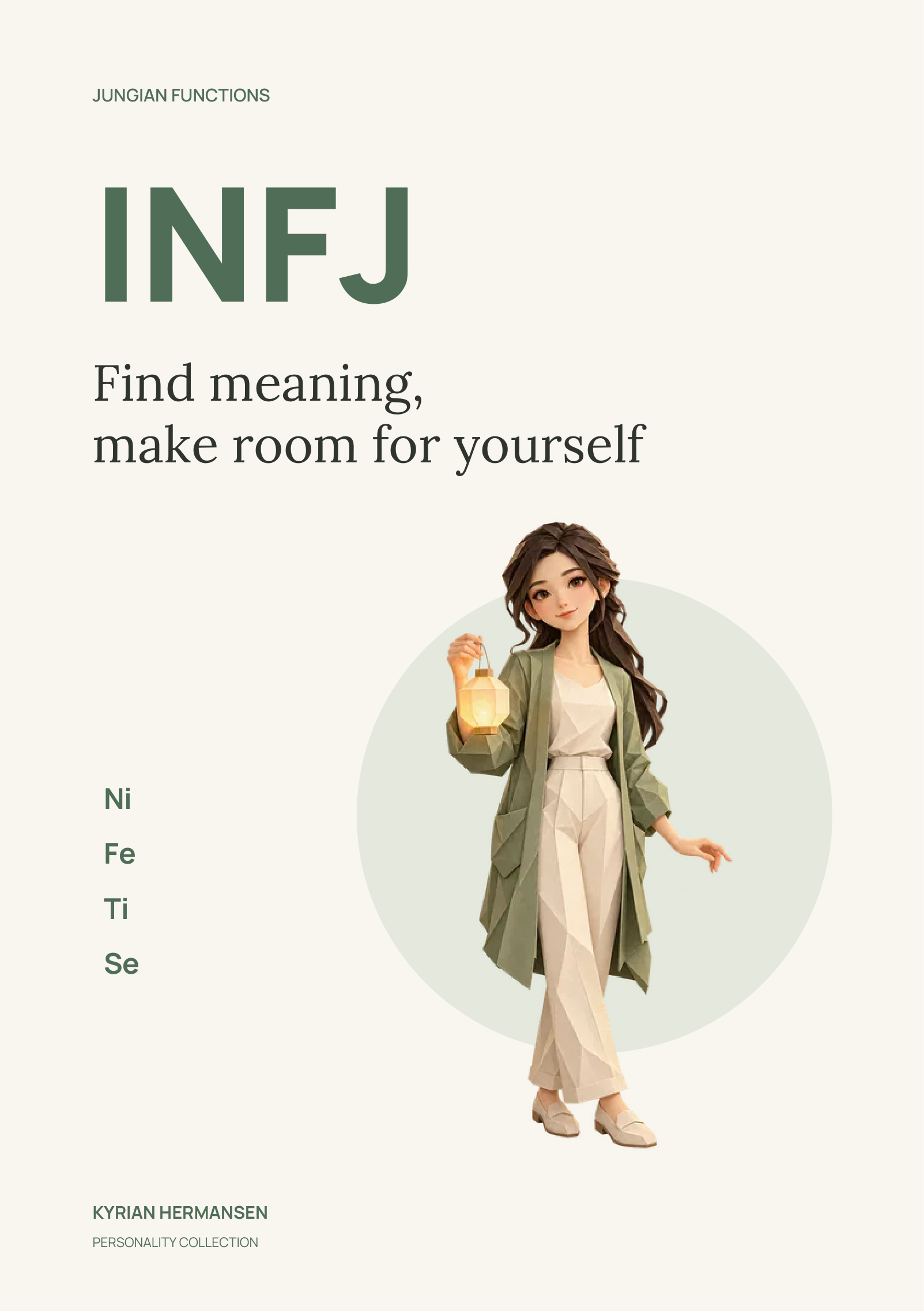
Ni · Fe · Ti · Se
To understand INFJ, look at the process
Two people can behave similarly for different reasons. That is why I put Jungian functions at the center of typing. I look at how someone takes in a situation and makes decisions, rather than inferring a type from a job, a flattering trait, or the state of a desk.
Introverted Intuition
Ni draws connections between clues to form an interpretation or an overall perspective. A conclusion may arrive before you can explain every step. Checking that impression against evidence matters: an account that feels coherent is still a hypothesis about the situation.
Extraverted Feeling
Fe notices relationships, shared expectations, and how a message is received. It can help you make an intention clear or recognize tension. Taking another person into account doesn’t require agreeing with everything they say or giving up your own view.
Introverted Thinking
Ti looks for internal consistency. It clarifies terms, distinguishes cases, and tests the connections between ideas. A rule can work in practice while leaving you dissatisfied if you cannot explain why. The risk is extending the analysis when an initial attempt could already teach you something useful.
Extraverted Sensing
Se attends to what is happening now: a visible detail, a material constraint, an immediate response. It brings a plan into contact with the situation. The book’s exercises often use this perspective to encourage observing before interpreting and trying before adding another assumption.
Dominant, auxiliary, tertiary, and inferior describe roles within this framework. “Inferior” does not mean absent, useless, or impossible to develop. Treat the order as a reference for reflection, not a ranking of your abilities.

At work: what helps, and what can get in the way
You may notice that a team uses the same words for different projects. One person wants speed, another wants participants to feel comfortable, and nobody has defined the expected result. Your contribution may be making that mismatch visible. The difficulty begins when noticing the problem first leaves you doing all the coordination. List the work you actually handle: reminders, meeting notes, clarification. Visible work is easier to share.
In relationships: make your intention visible
You may hope someone close to you will notice that something is wrong. If they do not, you might read the silence as a lack of interest when they do not know what you need. “I could use some time to talk. Are you available?” gives them a request they can answer. In return, ask what the other person meant before filling in their story. A strong impression deserves checking, especially when the relationship matters to you.
When pressure builds
When demands build up, you may become less patient, want more time alone, or replay conversations in your head. Also examine concrete conditions: fatigue, too little time, an unresolved disagreement, or uneven responsibilities. These reactions do not establish an INFJ type. Begin with something you can simplify or clarify. If you need time away, say when you will return so silence does not have to carry the entire message.
What if you’re considering several types?
INFJ and INTJ share dominant Ni in this reading, with Fe or Te as auxiliary: examine what you want to clarify when deciding with other people. INFJ and ENFJ use the same functions in a different order; social activity or ease in conversation cannot settle the distinction. With INFP, look at the initial process: an overall understanding meeting shared expectations, or a personal evaluation opening several possibilities. Return to multiple real situations, including those that challenge your first choice.
Try this with a situation of your own
Choose a recent, ordinary exchange you can examine calmly. First record the facts: the actual words or observed behavior. Write your interpretation, followed by another explanation compatible with those facts. Finish with a question that does not contain the answer you expect. Afterwards, note what changed in your understanding. You do not need to confirm a type for the experiment to be useful.
Digital book · English edition
Take a closer look with the INFJ book
I wrote this book to help you put impressions into words, check them, and make room for your needs in conversation. We take time to understand Ni, Fe, Ti, and Se, then examine them through ordinary situations and exercises you can adapt to your own life.
120 illustrated pages · A5 PDF · One-time payment
US$18
Your download link is provided after payment. No physical book will be shipped. This purchase includes the English edition only.
Keep exploring a real situation
Further reading: the Myers & Briggs Foundation introduction to type dynamics and processes
This is a typological framework. The function order shown is a common convention within this approach; schools differ in how they interpret development. This independent publication is not affiliated with the official MBTI® instrument. A type is neither a diagnosis nor a measure of your worth or abilities.