Introduction
Understanding the human personality has been a constant quest for psychologists, researchers and even the general public.
A tool that has contributed greatly to this exploration is the Myers-Briggs Type Indicator (MBTI), a psychometric instrument designed to measure psychological preferences and how individuals perceive the world and make decisions.
Since its inception, MBTI has been applied in a variety of areas, ranging from personal development to recruitment and human resources management, counselling and therapy.
This paper aims to provide an in-depth analysis of MBTI, exploring its origins, underlying theory, various uses, and validity and reliability.
By diving into the world of MBTI, I hope not only to broaden your understanding of this fascinating psychological tool, but also to stimulate a constructive dialogue on its role in our society and its potential for the future.
Origins and development of MBTI
The Myers-Briggs Type Indicator (MBTI), one of the most widely used personality profiling tools today, has interesting and varied origins. This is the result of decades of research and dedication on the part of Katherine Cook Briggs and her daughter, Isabel Briggs Myers.
Katherine Cook Briggs (1875-1968) was an educator and writer passionate about understanding human diversity. She first became interested in personality differences by observing the varied behaviors of her loved ones and friends. Her interest then grew by the reading of the works of the famous Swiss psychiatrist Carl Gustav Jung, in particular his book Psychological types published in 1921. Jung’s book presented his theory of psychological types based on four fundamental functions of consciousness – thinking, feeling, sensing and intuition – and two attitudes – extraversion and introversion.
Katherine then introduced her daughter, Isabel Briggs Myers (1897-1980), to Jung’s psychology. Together, they began to develop an indicator to help individuals discover their psychological type according to Jung’s theory. This was the beginning of the Myers-Briggs Type Indicator.
In the 1940s and 1950s, MBTI was developed and refined by testing thousands of people. Isabel Briggs Myers has tried to make Jung’s typology accessible to a wide audience, adding a fourth dimension (judgment and perception) to form the sixteen distinct personality types we know today in the MBTI.
In 1962, the MBTI was first published, providing a practical tool for assessing and categorizing personality types. Since its creation, it has been translated into many languages and used in a variety of contexts, from human resources management to psychotherapy.
Despite criticism and controversy, MBTI continued to be popular and widely used. It is a testimony to the pioneering work of Katherine Cook Briggs and Isabel Briggs Myers, whose passion for understanding individual differences has given rise to one of the most influential personality type indicators of our time.
Understanding the dimensions and types of personality of MBTI
The Myers-Briggs Type Indicator (MBTI) is based on four main dimensions of personality, each representing a continuum between two opposite ends.
Thus, individuals are identified by their preference in each dimension, resulting in a four-letter personality type. The dimensions and types of MBTI are as follows:
- Extraversion (E) versus Introversion (I): This dimension concerns the source and direction of an individual’s energy. Extraverts draw their energy from interaction with others and from the outside world, while introverts are more energized by moments of solitude and reflection.
- Sensing (S) versus Intuition (N): This dimension refers to how a person prefers to collect information. Sensing individuals focus on the present and concrete details, while those who prefer intuition are oriented towards the future and possibilities, and prefer a more abstract approach.
- Thinking (T) versus Feeling (F): This dimension describes how people make their decisions. Thinking individuals base their decisions on logic and objective analysis, while those who prefer Feeling make their decisions by focusing on personal values and emotional impact on others.
- Judging (J) versus Perceiving (P): This last dimension concerns how a person prefers to live his or her life. Judging individuals appreciate order, structure and planning, while those who are Perceiving are more flexible, spontaneous and prefer to keep their options open.
By combining these four dimensions, we obtain 16 distinct personality types, each identified by a four-letter code like INTJ or ESFP. These types are not rigid boxes in which we are locked, but rather useful indications of our natural preferences.
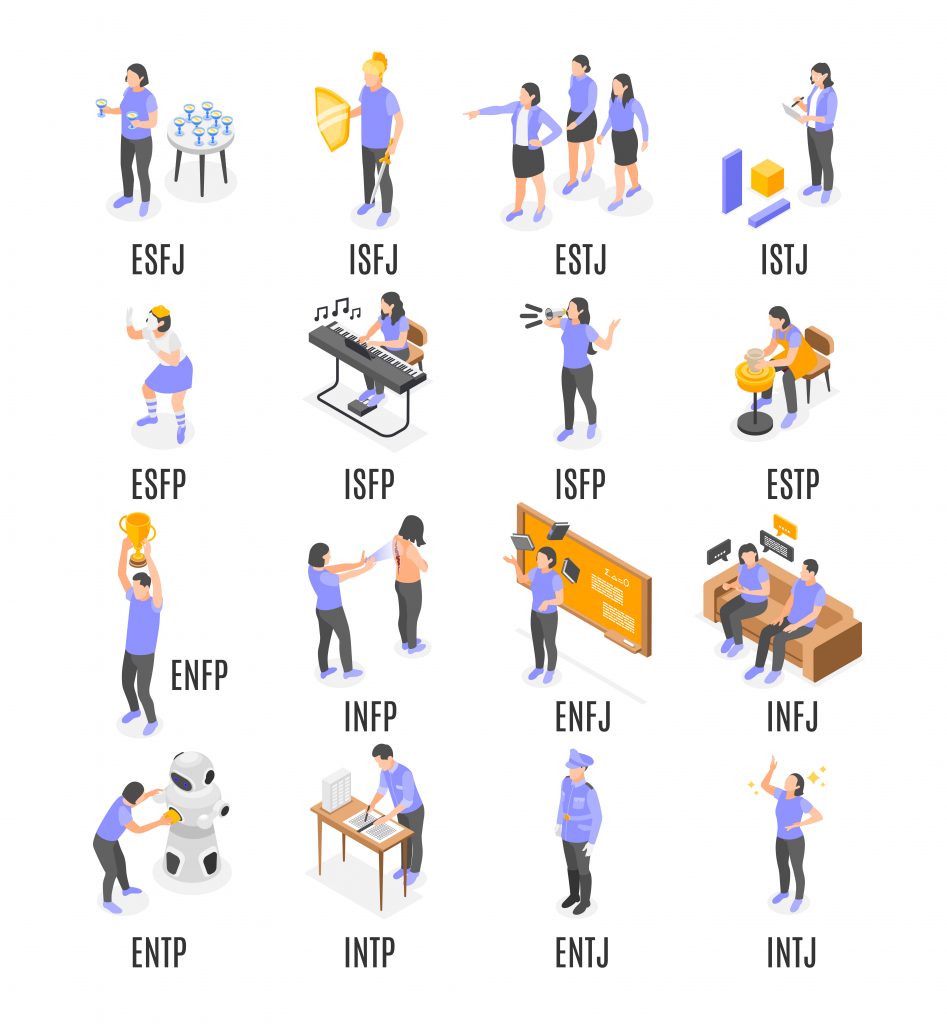
It is important to note that all types are equal in value and that each has unique strengths and weaknesses. Understanding our own type of personality can help us better understand our motivations, preferences and how we view the world. Similarly, it can promote tolerance and appreciation of those who are different from us.
Can we change MBTI?
– The answer is no!
– Yes, but yet I’ve done the test several times on 16personalities And I’ve had different results, so that means we can evolve.
– The answer is always no! Indeed, the model is based on the juxtaposition of Jungian functions (primary, auxiliary, tertiary, inferior) at different stages of life (infancy, adolescence, young adult, mid-life).
In this case, a change in life profile would include a retroactive change in function, which makes no sense.
The Jungian functions and the MBTI
The Jungian functions, on which the MBTI is partly based, number eight and fall according to the way a person perceives and judges the world. Each type of MBTI personality uses these functions differently, with a primary (or dominant) function, an auxiliary function, a tertiary function and a inferior function.
The following is a brief explanation of these functions and their order:
- Primary (or Dominant) function: This is the most natural and dominant function of an individual. This is the main way in which a person interacts and understands the world. It is generally well developed at the end of childhood. As‘INTJ, I have Introverted Intuition and when I see the videos of when I was little it’s true that I look like a little autist lost in his head.
- Auxiliary function: This function supports and complements the dominant function. Although it is less predominant than the primary function, it plays an essential role in how a person interacts with the world. It is often visible to others and can be used to make decisions that are not made by the dominant function. She intervenes in adolescence.
- Tertiary function: This function is less developed than the first two, but it can still be used effectively if needed. Over time and practice, this function can become stronger and more integrated in the way a person works on a daily basis. It develops at the beginning of adulthood and begins to be well controlled at about 30 years of age.
- Inferior function: This is the least developed and least conscious function. Also, it can often be a source of unexpected behaviours and reactions, especially under stress or fatigue. However, by aging, a person can learn to recognize and use this function in a more positive way. She starts to be mastered at mid-life, either, about 40 years old.
What exactly are the Jungian functions?
The eight Jungian functions are as follows:
- Extraverted Thinking (Te)
- Description: People who use Te focus on logic, efficiency and objectivity. They make decisions based on concrete facts and external standards. They are organized, plan and like the structure.
- Example: Organize a project by defining clear steps and delegating tasks to ensure its success.
- Introverted Thinking (Ti)
- Description: Ti analyzes and categorizes information to understand how things work. He looks for precision and likes to solve problems. It focuses more on internal understanding than on external application.
- Example: In-depth analysis of a concept or idea to understand its foundations.
- Extraverted Feeling (Fe)
- Description: Fe focuses on connecting with others. He makes decisions based on group harmony, collective morality and cooperation. He is attentive to the needs and feelings of others.
- Example: Organize a surprise party for a friend, taking into account each guest’s preferences.
- Introverted Feeling (Fi)
- Description: Fi is guided by an internal set of values, emotions and convictions. He seeks authenticity and makes decisions based on what is important to him personally.
- Example: Choose to follow a professional path that is consistent with your personal values.
- Extraverted Sensing
- Description: Focused on the immediate experience and present moment. He is attentive to details and reacts to external stimuli. He’s looking for action and experience.
- Example: Enjoy extreme sport or immersive experience to feel adrenaline.
- Introverted Sensing (Si)
- Description: Based on past experiences and memory. It is detailed and methodical, with a strong ability to connect the present to the past. He seeks stability and tradition.
- Example: Remembering and sharing a family tradition at a family reunion.
- Extraverted Intuition (Ne)
- Description: Ne sees possibilities, links and connections between ideas. It is creative, adaptable and enjoys exploring new ideas.
- Example: Brainstorming for a project, linking seemingly unrelated ideas.
- Introverted Intuition (Ni)
- Description: Ni has an internal vision and focuses on future perceptions, visions and impressions. It emphasizes long-term perspectives and underlying patterns.
- Example: To plan a future trend based on an intuition or a deep understanding of a current situation.
Example
Each type of MBTI personality has a specific order for these functions. For example, INTJ would have:
- Primary: Introverted Intuition (Ni)
- Auxiliary: Extraverted Thinking (Te)
- Tertiary: Introverted Feeling (Fi)
- Inferior: Extraverted Sensing (Se)
Understanding this order of duties can help to understand how a person perceives, thinks and feels about the world around him.
Application of MBTI
The uses of MBTI are vast and varied, and extend far beyond mere personal curiosity. Some of the areas where MBTI is applied include:
- Personal Development: MBTI can help individuals better understand each other, identify their strengths and identify potential areas for improvement. It is a valuable tool to explore different aspects of his personality and to understand how his individual preferences influence his perceptions, motivations and behaviours.
- Coaching and Career Development: Orientation coaches and counsellors often use MBTI to help their clients explore their career interests and identify professional environments that might be most compatible with their personality type.
- Teamwork and Leadership: In business, MBTI is a valuable tool for team building, leadership development and conflict resolution. It can help create a better understanding and appreciation of personality differences, which can improve the communication, collaboration and effectiveness of the team.
- Relationships: MBTI can also help improve personal relationships. Understanding personality differences can help improve communication, resolve conflicts and build stronger and more satisfying relationships.
- Education: Many educators use MBTI to help students understand their preferred learning style and develop more effective study strategies.
However, despite its many applications, it is important to remember that MBTI should never be used to predict behaviour, judge competence, or limit an individual’s opportunities. As Carl Jung himself said, “People are more than their typology.”
Criticisms and Controversies of MBTI
While MBTI has been widely successful as a tool for assessing personality, it has also been the subject of criticism and controversy among researchers and psychology professionals. These reviews focus mainly on two aspects: the validity and reliability of the tool.
- Validity of MBTI: Some researchers point out that MBTI does not always correspond to modern personality models based on Big Five theory. In addition, they question the idea of distinct personality types and suggest that personality is presented as continuous or spectral.
- Reliability of MBTI: It was also noted that MBTI results may vary for the same person at different times. This lack of temporal stability calls into question the reliability of MBTI as an assessment tool.
- Inappropriate Use of MBTI: Another concern is the inappropriate use of MBTI, particularly when it is used to predict job performance, to select candidates for hiring, or to categorize people rigidly.
Despite these criticisms, MBTI continues to be widely used and appreciated for its ease of use, accessibility, and ability to encourage introspection and discussion of individual differences.
The future of MBTI and recent developments
The future of MBTI is promising, despite the criticisms and controversies it has generated. Many practitioners and researchers still see value in this tool for its use in various contexts.
- MBTI in Coaching and Personal Development: MBTI is widely used in life coaching and personal development. It helps individuals better understand each other and others, which can lead to better communication and healthier interpersonal relationships.
- MBTI in Business and Organizations: Organizations continue to use MBTI for team development and leadership. It is also used to resolve conflicts and improve team dynamics.
- New versions of the MBTI: Recent versions of the MBTI, such as the MBTI Step II, attempt to respond to some of the criticisms by proposing sub-scales that recognize variability within personality types. These recent developments aim to improve the precision and flexibility of the tool.
- MBTI and Future Research: Ongoing research on MBTI focuses on improving its validity and reliability, and exploring its use in new contexts, such as mental health and psychological well-being.
Conclusion
In conclusion, MBTI, despite its challenges and criticisms, remains a valuable tool in the field of personality psychology.
It is crucial to stress that MBTI, like any psychometric tool, must be used ethically and responsibly. It must be seen as a guide to understanding personality and not as an absolute definition of an individual’s identity.
It is also important to note that MBTI is not intended to assess mental health or serve as a selection criterion for employment. Its purpose is to promote understanding and acceptance of oneself and others, not to stigmatize or exclude.
In conclusion, MBTI remains a valuable tool for enlightening the nuances of human personality. It offers a language to articulate and understand our differences, which can foster better communication, better relationships and greater empathy with others. As Carl Jung wrote, “What makes us understand is the clarity of our perception, not what we believe to be true.”