MBTI PERSONALITY PROFILE · ISTP
The ISTP personality: thinking independently, staying connected
An explanation can seem clear to everyone else and still leave you with a question. You want to see how it holds together, try it, and understand its limits. Sometimes people mistake your silence for disagreement when you are still thinking.
By Kyrian Hermansen · A function-based reading

ISTP descriptions often emphasize tools, independence, and composure. I think they can miss something essential: how understanding develops. You may enjoy ideas, books, precise conversations, or making things. For typing, I care about the reasons guiding your attention and decisions. Functions let us examine them without requiring you to play the person who fixes everything and says nothing. They also leave room for attachment, uncertainty, and enjoying an activity without optimizing it.
What does ISTP mean?
ISTP stands for Introversion, Sensing, Thinking, and Perceiving in the MBTI framework. These letters measure neither sociability, intelligence, nor technical ability. In the interpretation used here, Introverted Thinking, Ti, is dominant, supported by Extraverted Sensing, Se. Ni and Fe complete the alternating-stack convention. This order raises questions about perception and judgment; it does not list abilities reserved for ISTPs.
Someone presents a method. You ask why a step is necessary, then observe what happens when it is applied. If the explanation remains unclear, accepting it merely because it is familiar may be difficult. That curiosity can help. It also benefits from being understandable: the other person may not know whether you want to learn, criticize the proposal, or refuse to begin. Saying “I want to understand this point before choosing” can protect thinking space while opening the discussion.
Ti · Se · Ni · Fe
To understand ISTP, look at the process
Two people can behave similarly for different reasons. That is why I put Jungian functions at the center of typing. I look at how someone takes in a situation and makes decisions, rather than inferring a type from a job, a flattering trait, or the state of a desk.
Introverted Thinking
Ti looks for internal consistency. It clarifies terms, distinguishes cases, and tests the connections between ideas. A rule can work in practice while leaving you dissatisfied if you cannot explain why. The risk is extending the analysis when an initial attempt could already teach you something useful.
Extraverted Sensing
Se attends to what is happening now: a visible detail, a material constraint, an immediate response. It brings a plan into contact with the situation. The book’s exercises often use this perspective to encourage observing before interpreting and trying before adding another assumption.
Introverted Intuition
Ni draws connections between clues to form an interpretation or an overall perspective. A conclusion may arrive before you can explain every step. Checking that impression against evidence matters: an account that feels coherent is still a hypothesis about the situation.
Extraverted Feeling
Fe notices relationships, shared expectations, and how a message is received. It can help you make an intention clear or recognize tension. Taking another person into account doesn’t require agreeing with everything they say or giving up your own view.
Dominant, auxiliary, tertiary, and inferior describe roles within this framework. “Inferior” does not mean absent, useless, or impossible to develop. Treat the order as a reference for reflection, not a ranking of your abilities.

At work: what helps, and what can get in the way
You may appreciate instructions that define an outcome while leaving the method open. Ask what is actually negotiable: timing, steps, criteria, or communication. A first trial and review point can provide visibility without constant supervision. When changing something others use, explain what changed and why. Autonomy becomes easier to share when people know what they can rely on and what remains to be checked.
In relationships: make your intention visible
You may express care through an action or specific help. Its intention is not always obvious, even when the gesture seems self-explanatory. A few words can make it clearer. Ask whether someone wants a solution, listening, or simply time together. You can state your availability too. A concrete boundary gives conversation more room than silence whose meaning everyone invents. ISTP alone says nothing about your capacity to love or build a caring relationship.
In love, you may appreciate closeness that leaves space for both people. Sharing an activity, being there when help is needed or spending time together without filling every silence may mean a great deal to you. Your partner may nevertheless need clearer signals to understand your feelings. A few words, an initiative or a confirmed date makes your intention easier to recognize. You can ask for time alone while explaining when you will reconnect. Our article on ISTP romantic compatibility with all 16 MBTI types explores all 16 pairings through practical situations. You will find ways to discuss independence, tenderness and commitments. These examples help you seek a pace where each person can breathe and feel considered. Your relationship can keep a quiet, personal style while giving both people enough information to understand what they can count on.
When pressure builds
As demands accumulate, replies may shorten or interruptions become harder. These responses occur across types. Examine commitments, available time, and missing information. What can be postponed, shared, or clarified? Functions may help frame a question without explaining every difficulty. During an ordinary busy week, making one responsibility explicit is often more useful than immediately assigning a label to each reaction.
What if you’re considering several types?
INTP shares dominant Ti; comparison concerns Se and Ne, returning to present experience or exploring possibilities, without dividing manual from intellectual people. ESTP shares Ti and Se in reverse order: observe what organizes your approach to unfamiliar situations beyond speaking time. ISFP shares auxiliary Se; Ti and Fi invite examination of internal consistency and alignment with personal values. Both types can reason carefully and feel strongly. Return to the reasons behind several decisions, including those resisting your initial hypothesis.
Try this with a situation of your own
Choose a recent small decision. Record the intended result, important criterion, and actual observations. Separate your conclusion from the facts. What information could change your view? Explain the reasoning briefly to someone and ask what they understand. The exercise may reveal an unclear word, overlooked need, or already solid agreement. It is not a point-scoring method for confirming ISTP.
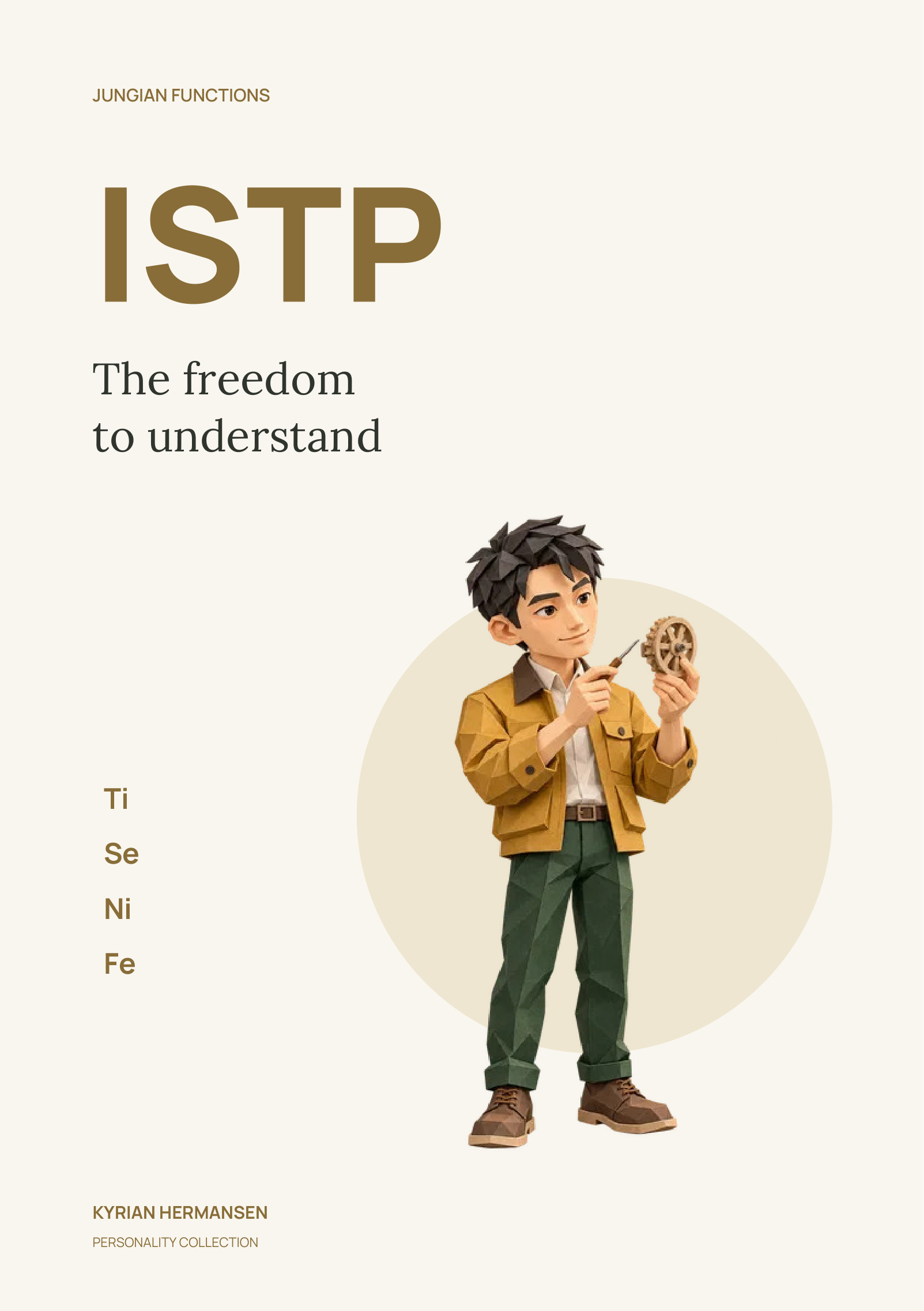
Digital book · English edition
Take a closer look with the ISTP book
This book gives Ti, Se, Ni, and Fe time to make sense through a continuing story and ordinary situations. We examine understanding, trials, intuitions worth checking, and intentions worth explaining. You will find comparisons with INTP, ESTP, and ISFP, followed by four weeks of observation. I want to offer reference points for examining your choices without turning independence into an obligation to understand everything alone.
120 illustrated pages · A5 PDF · One-time payment
US$18
Your download link is provided after payment. No physical book will be shipped. This purchase includes the English edition only.
Keep exploring a real situation
Further reading: the Myers & Briggs Foundation introduction to type dynamics and processes
This is a typological framework. The function order shown is a common convention within this approach; schools differ in how they interpret development. This independent publication is not affiliated with the official MBTI® instrument. A type is neither a diagnosis nor a measure of your worth or abilities.