MBTI PERSONALITY PROFILE · ESFJ
The ESFJ personality: building connection, keeping your voice
You notice the person who hasn’t found a place yet. You remember a detail that matters to them. And sometimes, after making a gathering comfortable for everyone else, you realize you never said what you wanted yourself.
By Kyrian Hermansen · A function-based reading

ESFJ descriptions often emphasize generosity, sociability, and duty. I think the actual person can get lost: someone who enjoys bringing people together and sometimes needs quiet, values a tradition and wants it to change, or cares deeply about a relationship while disagreeing. To understand this profile, I would rather examine how you form judgments and what shapes your perception. Functions make those questions more precise than a list of supposed strengths. They also leave room for situations in which the portrait does not fit.
What does ESFJ mean?
ESFJ stands for Extraversion, Sensing, Feeling, and Judging in the MBTI framework. These letters do not require constant availability, enthusiasm for every party, or putting everyone ahead of yourself. In the interpretation used here, Extraverted Feeling, Fe, is dominant, supported by Introverted Sensing, Si. Ne and Ti complete the alternating-stack convention. This order describes theoretical preferences in perception and judgment; it measures neither kindness nor competence.
You are planning dinner and considering everyone’s preferences. One person likes arriving early, another knows nobody, and a third has requested a quiet seat. That attention can make a welcome easier. But some expectations were expressed, while others came from your assumptions. The portrait becomes useful when you distinguish them. Did you ask what people would enjoy? Did you state your own preference? A shared occasion can include a question, disagreement, and a clear boundary. You do not need to guess everything for others to feel considered.
Fe · Si · Ne · Ti
To understand ESFJ, look at the process
Two people can behave similarly for different reasons. That is why I put Jungian functions at the center of typing. I look at how someone takes in a situation and makes decisions, rather than inferring a type from a job, a flattering trait, or the state of a desk.
Extraverted Feeling
Fe notices relationships, shared expectations, and how a message is received. It can help you make an intention clear or recognize tension. Taking another person into account doesn’t require agreeing with everything they say or giving up your own view.
Introverted Sensing
Si compares current experience with established reference points: what happened before, what has changed, and which conditions helped. Keeping a record of an attempt can support the next one. Previous experience gives you a comparison, without guaranteeing that this situation will be the same.
Extraverted Intuition
Ne notices alternatives, makes connections, and asks what else could change. One detail can suggest a whole new approach. This flexibility helps you move beyond a habitual answer. It also needs a point where you choose an experiment instead of continually reopening the possibilities.
Introverted Thinking
Ti looks for internal consistency. It clarifies terms, distinguishes cases, and tests the connections between ideas. A rule can work in practice while leaving you dissatisfied if you cannot explain why. The risk is extending the analysis when an initial attempt could already teach you something useful.
Dominant, auxiliary, tertiary, and inferior describe roles within this framework. “Inferior” does not mean absent, useless, or impossible to develop. Treat the order as a reference for reflection, not a ranking of your abilities.

At work: what helps, and what can get in the way
In a team, you may notice information that fails to circulate or tasks nobody has actually accepted. This helps when it leads to clearer agreements. It becomes burdensome when you automatically absorb whatever is missing. Make the work visible: the task, the person accepting it, and what still needs assigning. A shared list can prevent coordination from depending entirely on your memory. Your assumed type determines neither your professional role nor how much work you should carry.
In relationships: make your intention visible
When someone describes a difficulty, you may immediately want to help. First ask what would be useful: listening, finding a solution, or simply spending time together. You can also state what you are able to offer. Specific availability is more useful than a yes you cannot sustain. Closeness does not remove the need to ask. The other person may want something different from what you imagined; your own preference deserves to be heard too.
In a relationship, you may enjoy moments that help you feel close: talking after the day, receiving a personal gesture or planning something together. You may also want your partner to know the people who matter to you. It helps to find a pace that suits both of you, with time together and room to rest separately. Your expectations deserve to be expressed even when you readily understand other people’s needs. Our article on ESFJ romantic compatibility with all 16 MBTI types explores all 16 pairings through everyday scenes. You will find ways to discuss appreciation, social life and how each person expresses affection. These examples can help clarify what brings you closer and which adjustments you would like to try. Your shared history still deserves to be understood through your actual choices, experiences and conversations.
When pressure builds
When requests accumulate, examine actual commitments before explaining every response through type. Have you accepted too much? Did expectations remain unspoken? What can be shared, postponed, or removed? Fatigue, context, and available resources affect every type. Clarifying a single responsibility can help during an ordinary busy week. Function vocabulary can support reflection, but it cannot replace attention to circumstances or appropriate support for persistent difficulty.
What if you’re considering several types?
ISFJ shares Fe and Si in a different order: examine what usually organizes your understanding rather than your ease at parties. ENFJ shares dominant Fe; the comparison involves Si and Ni, familiar subjective experience or an overall interpretation, without dividing routine from imagination. ESTJ shares auxiliary Si, while Te and Fe emphasize different judgment criteria. Both can be organized and considerate. Compare the reasons behind several actual decisions, including those that challenge your starting hypothesis.
Try this with a situation of your own
Choose a situation where you believe you know someone’s expectation. Record what they actually said, what you assumed, and what you want yourself. Ask a question that genuinely permits a different answer. Then state what you can offer. Afterward, notice what changed through checking. The aim is to understand an agreement better, not score points toward confirming ESFJ.
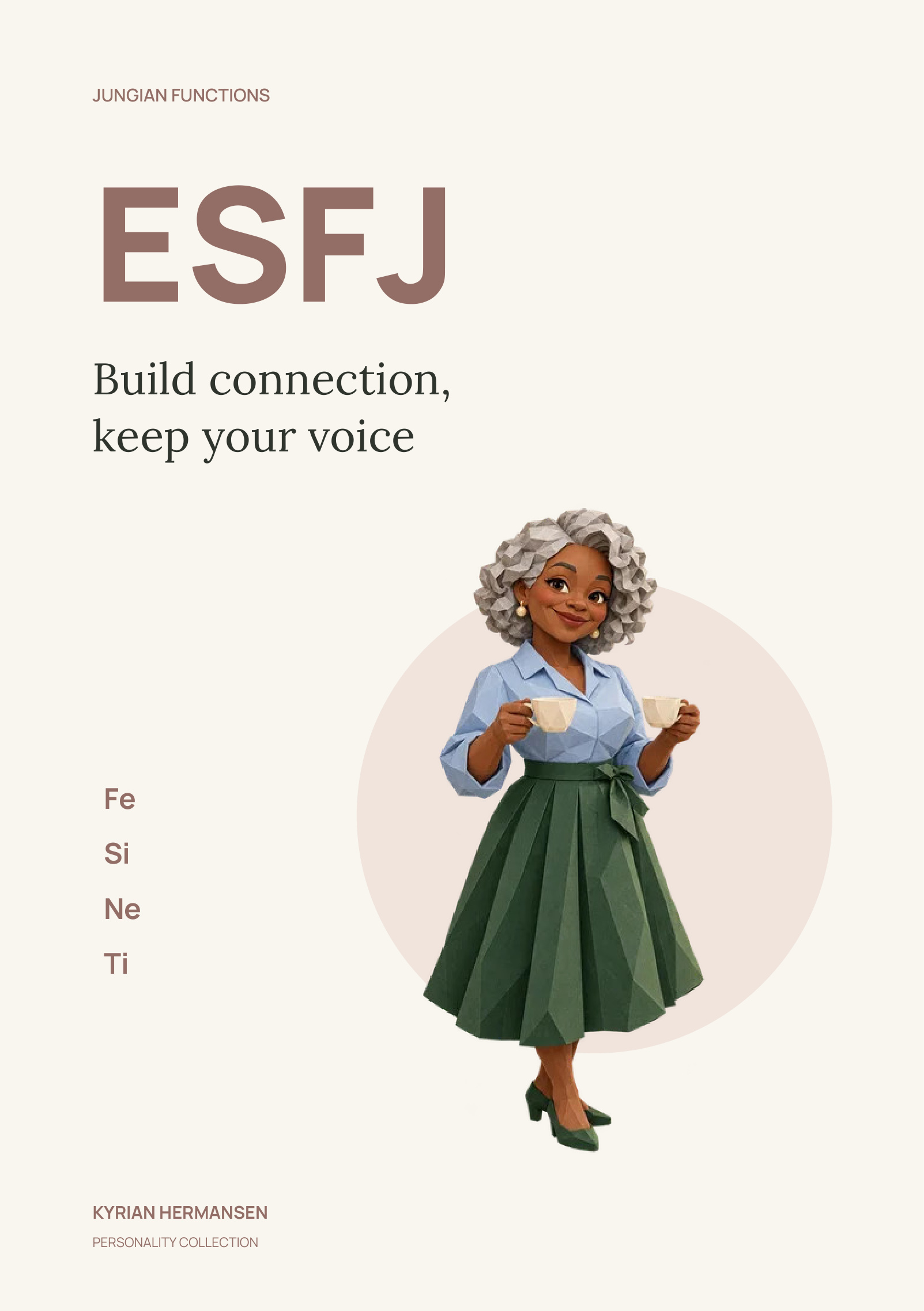
Digital book · English edition
Take a closer look with the ESFJ book
I built this book around Fe, Si, Ne, and Ti, allowing time to explain each function through a continuing story. We examine unspoken expectations, memories shaping the present, new possibilities, and rules worth understanding. You will find comparisons with ISFJ, ENFJ, and ESTJ, followed by four weeks of observation. I want to help you recognize your own reasons, including when you prefer quiet, set a boundary, or disagree with the group.
120 illustrated pages · A5 PDF · One-time payment
US$18
Your download link is provided after payment. No physical book will be shipped. This purchase includes the English edition only.
Keep exploring a real situation
Further reading: the Myers & Briggs Foundation introduction to type dynamics and processes
This is a typological framework. The function order shown is a common convention within this approach; schools differ in how they interpret development. This independent publication is not affiliated with the official MBTI® instrument. A type is neither a diagnosis nor a measure of your worth or abilities.