MBTI PERSONALITY PROFILE · ENTJ
The ENTJ personality: you can already see the next step
You can see what needs to happen. Making room for everyone involved—including yourself—can be the harder part.
By Kyrian Hermansen · A function-based reading

The meeting keeps going. Everyone understands the problem, several ideas are on the table, and nobody has picked a next step. You suggest a plan, a deadline, and someone to own the task. One person looks relieved. Another wonders when they were asked. That difference in reactions is worth understanding.
What does ENTJ mean?
In the MBTI framework, ENTJ stands for Extraversion, Intuition, Thinking, and Judging. These preferences describe an outward orientation, attention to possibilities and patterns, the use of logical criteria, and a preference for organized decisions. They don’t tell us how loudly you speak or how well you lead a team.
You can enjoy bringing order to a situation without wanting to be in charge. You might sound certain while you’re still testing an idea. The familiar “Commander” nickname leaves out those details. A more useful question is what drives your decisions: what needs to work, where is it heading, and what does it ask of the people involved?
Te · Ni · Se · Fi
To understand ENTJ, look at the process
Two people can behave similarly for different reasons. That is why I put Jungian functions at the center of typing. I look at how someone takes in a situation and makes decisions, rather than inferring a type from a job, a flattering trait, or the state of a desk.
Extraverted Thinking
Te attends to resources, visible criteria, and the organization of action. Who owns the next step? How will we know whether it works? It helps make an intention usable by other people. One limitation to watch for is treating what is easy to measure as everything that matters.
Introverted Intuition
Ni draws connections between clues to form an interpretation or an overall perspective. A conclusion may arrive before you can explain every step. Checking that impression against evidence matters: an account that feels coherent is still a hypothesis about the situation.
Extraverted Sensing
Se attends to what is happening now: a visible detail, a material constraint, an immediate response. It brings a plan into contact with the situation. The book’s exercises often use this perspective to encourage observing before interpreting and trying before adding another assumption.
Introverted Feeling
Fi considers whether a decision fits your personal values. A practical solution can leave an uneasiness you cannot immediately explain. Naming what feels wrong can help you communicate a boundary. It doesn’t make other people’s needs less relevant.
Dominant, auxiliary, tertiary, and inferior describe roles within this framework. “Inferior” does not mean absent, useless, or impossible to develop. Treat the order as a reference for reflection, not a ranking of your abilities.
At work: what helps, and what can get in the way
Your contribution to a project may be practical: noticing a dependency, cutting an unnecessary step, or making ownership clear. Trouble can start when hesitation looks like wasted time. Someone may be holding information your plan doesn’t account for. Before assigning the work, try asking, “What seems unrealistic about this?” Give the answer enough room to change your proposal.
In relationships: make your intention visible
When someone you care about describes a problem, you may have a solution before they finish. Offering a plan can be your way of showing up. They may need you to understand the experience first. “Would you like help thinking this through, or would you rather I just listen?” is a small question with a practical effect: it tells you what kind of help is welcome.
When pressure builds
When you feel responsible for everything, you may tighten control, make faster decisions, and lose patience with detours. Look at the conditions around that response: too little rest, unclear responsibilities, or a goal that no longer fits the resources. Stress behavior alone cannot establish a personality type. It can give you a reason to reconsider how much you’re carrying.
What if you’re considering several types?
ENTJs and INTJs use the same four functions in a different order in this framework. ENTJs tend to begin with what needs organizing; INTJs tend to give their understanding of the situation more time to settle. Compared with ENTPs, the useful distinction is often between choosing a workable direction and continuing to open up possibilities. Look at your usual process, including situations where nobody expects you to lead.
Try this with a situation of your own
Choose a recent decision. Write down the result you wanted, the assumption behind your plan, a detail that surprised you, and something you personally wanted to protect. These are four ways to explore Te, Ni, Se, and Fi. Then check one of your assumptions with someone affected by the decision.
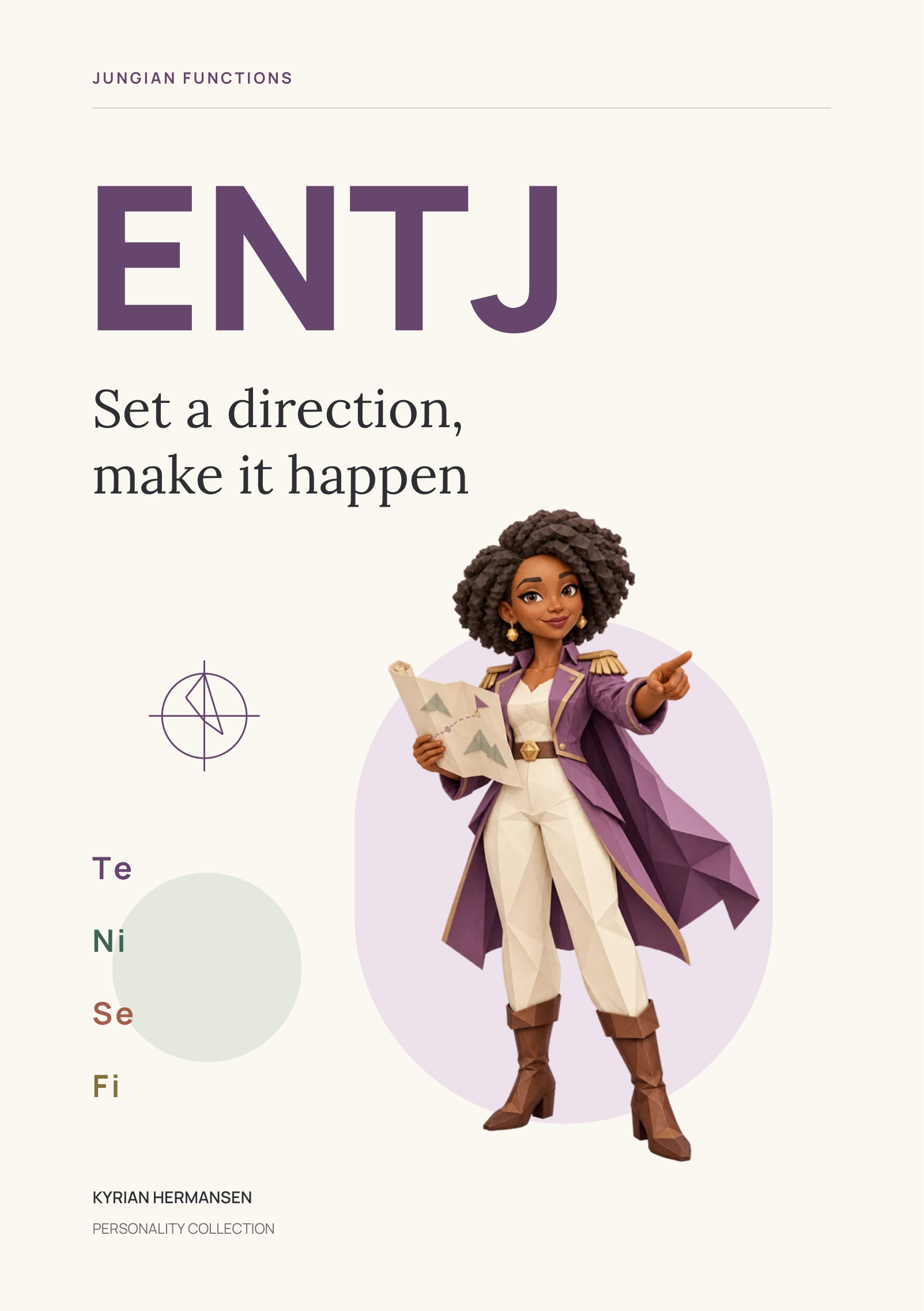
Digital book · English edition
Take a closer look with the ENTJ book
I wrote this book for the moments when being effective doesn’t answer every question. It gives you a way to examine how you make decisions, involve other people, and recognize the priorities you may have pushed behind the goal.
120 illustrated pages · A5 PDF · One-time payment
US$18
Your download link is provided after payment. No physical book will be shipped. This purchase includes the English edition only.
Keep exploring a real situation
Further reading: the Myers & Briggs Foundation introduction to type dynamics and processes
This is a typological framework. The function order shown is a common convention within this approach; schools differ in how they interpret development. This independent publication is not affiliated with the official MBTI® instrument. A type is neither a diagnosis nor a measure of your worth or abilities.