MBTI PERSONALITY PROFILE · ENFP
The ENFP personality: choosing which ideas to follow
A conversation opens one possibility. You can already see three more. Then comes the choice: which one will you give your time to, while keeping what made it appealing in the first place?
By Kyrian Hermansen · A function-based reading

You may know the gap: in your mind, the project already has several forms; on the table, you still need to decide where to begin. You might enjoy exploring, talking, and connecting things that seemed unrelated. You may also need quiet to know what you want to keep. That transition interests me in ENFP: how a possibility appears, how it meets your values, and what helps it become more than a promising idea in a notebook.
What does ENFP mean?
ENFP stands for Extraversion, Intuition, Feeling, and Perceiving in the MBTI framework. Extraversion does not mean talking constantly. Feeling concerns a way of evaluating what matters, and P predicts neither messiness nor lateness. In the function-based interpretation used here, we examine Ne, Fi, Te, and Si. These terms help explore a process, with its qualifications, rather than assign admirable qualities.
The endlessly sunny personality portrait leaves little room for ordinary days. You can have many ideas and feel tired. You can enjoy novelty and keep habits that make life easier. You can understand several perspectives without immediately knowing which reflects your own. To discuss ENFP, I would rather examine a specific decision: what caught your attention, which possibilities appeared, and what led you to choose? Your reasoning tells me more than a personality nickname.
Ne · Fi · Te · Si
To understand ENFP, look at the process
Two people can behave similarly for different reasons. That is why I put Jungian functions at the center of typing. I look at how someone takes in a situation and makes decisions, rather than inferring a type from a job, a flattering trait, or the state of a desk.
Extraverted Intuition
Ne notices alternatives, makes connections, and asks what else could change. One detail can suggest a whole new approach. This flexibility helps you move beyond a habitual answer. It also needs a point where you choose an experiment instead of continually reopening the possibilities.
Introverted Feeling
Fi considers whether a decision fits your personal values. A practical solution can leave an uneasiness you cannot immediately explain. Naming what feels wrong can help you communicate a boundary. It doesn’t make other people’s needs less relevant.
Extraverted Thinking
Te attends to resources, visible criteria, and the organization of action. Who owns the next step? How will we know whether it works? It helps make an intention usable by other people. One limitation to watch for is treating what is easy to measure as everything that matters.
Introverted Sensing
Si compares current experience with established reference points: what happened before, what has changed, and which conditions helped. Keeping a record of an attempt can support the next one. Previous experience gives you a comparison, without guaranteeing that this situation will be the same.
Dominant, auxiliary, tertiary, and inferior describe roles within this framework. “Inferior” does not mean absent, useless, or impossible to develop. Treat the order as a reference for reflection, not a ranking of your abilities.

At work: what helps, and what can get in the way
A proposal becomes easier to share when others know what you need from them. Are you seeking ideas, feedback, or a decision? Say so. When you think aloud, “we could” can sound like a commitment. When accepting a task, specify what should exist at the end. A first clip, a mockup, or a trial page offers a concrete reference point. Keep interesting alternatives in a note, then give the chosen option enough time to teach you something through making it.
In relationships: make your intention visible
Someone describes a difficulty and you immediately see several solutions. They might help. Or the person may first want to be heard. A question often makes your support more responsive: “Would you like to explore options, or would you rather tell me about it for now?” Your own wishes deserve expression too. Understanding the appeal of every option does not require joining every project. You can appreciate an invitation, consider the space it will take, and respond with your actual availability.
When pressure builds
When projects accumulate, everything can stay open at once: messages, decisions, and small revisions. Before treating that as evidence of type, examine workload and missing information. Choose what needs clarifying, reducing, or postponing. If you keep revisiting a detail, ask which check would actually provide new information. An MBTI portrait cannot fully explain a persistent difficulty; it may simply help you formulate more specific questions.
What if you’re considering several types?
ENFP and ENTP share Ne in this interpretation, so enjoying ideas does not distinguish them. Examine Fi or Ti support: the role of personal evaluation and of coherence in reasoning. With INFP, compare Ne–Fi and Fi–Ne: does an encountered possibility help you clarify what matters, or do you begin with a concern and seek a suitable form? With ESFP, observe Ne and Se, suggested possibilities and direct contact with the situation. None of these comparisons measures creativity, depth, or intelligence.
Try this with a situation of your own
Choose an idea you want to pursue this week. Record what prompted it, then two possible forms. Write what you want to preserve in the choice and the smallest result that would already be useful. Run a trial and keep a record of what actually happened. You will have experience through which to discuss Ne, Fi, Te, and Si, including its questions and surprises.
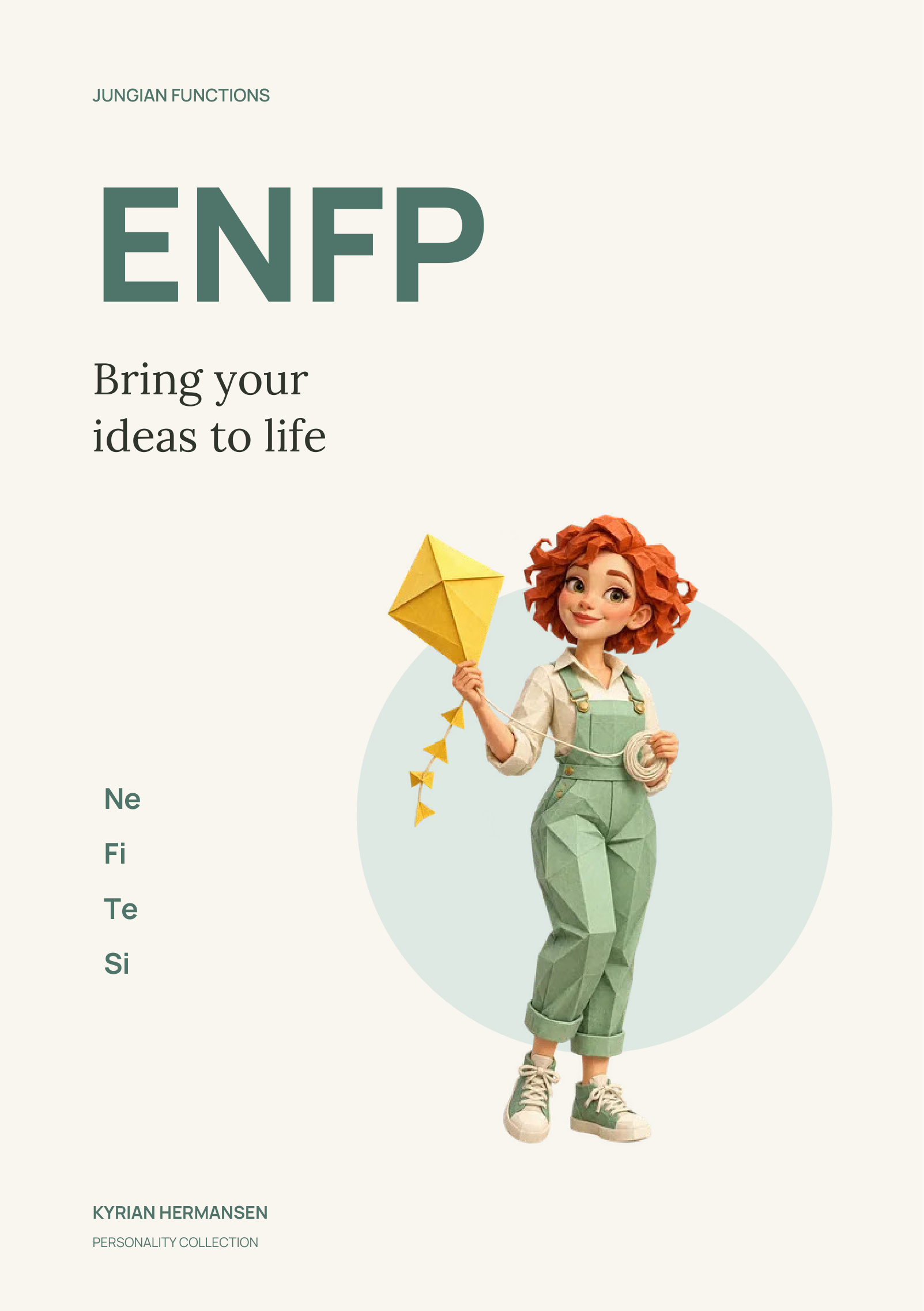
Digital book · English edition
Take a closer look with the ENFP book
I wrote this book to explain the functions beyond an enthusiastic personality portrait. We follow an idea, the reasons for choosing it, the conversations it prompts, and the work needed to share it. You will find examples to examine, comparisons with neighboring types, and exercises you can bring to a project in your own life.
120 illustrated pages · A5 PDF · One-time payment
US$18
Your download link is provided after payment. No physical book will be shipped. This purchase includes the English edition only.
Keep exploring a real situation
Further reading: the Myers & Briggs Foundation introduction to type dynamics and processes
This is a typological framework. The function order shown is a common convention within this approach; schools differ in how they interpret development. This independent publication is not affiliated with the official MBTI® instrument. A type is neither a diagnosis nor a measure of your worth or abilities.