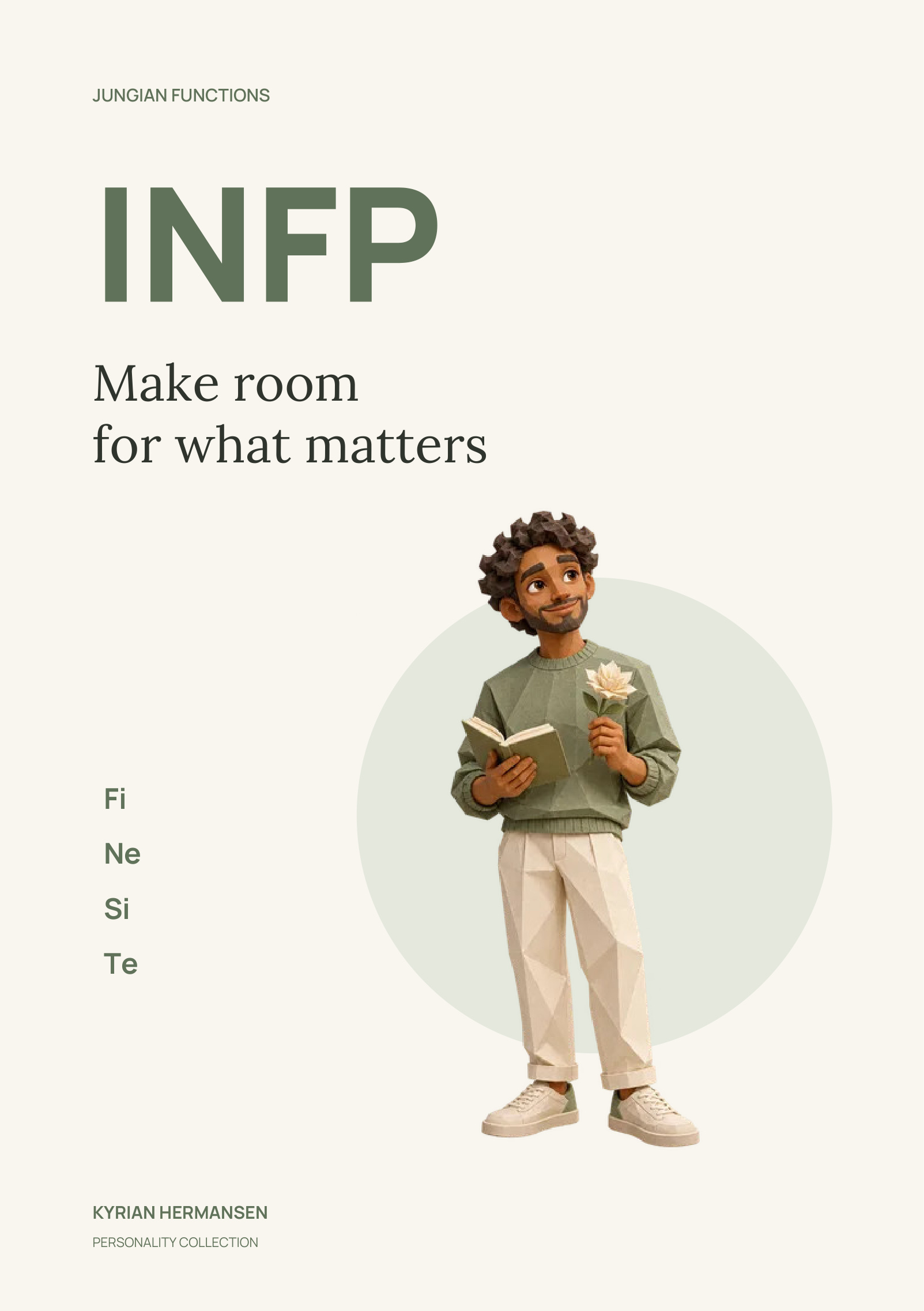
INFP · KYRIAN HERMANSEN
Make room for what matters
You can imagine several ways forward and still hesitate before saying yes. Sometimes you are looking for the words to explain what that choice would mean to you.
A 120-page illustrated book that explores the INFP personality through Jungian functions and connects them to the decisions and relationships in your daily life.
US$18 · English edition
A5 PDF · One-time payment · No subscription
You recognize the four letters. What comes next?
An offer can look appealing on paper and still leave you with a hesitation you cannot quite explain. You may not yet know whether it conflicts with a value, whether information is missing, or whether you simply need time. That internal work interests me when I talk about INFP. I want to examine how a view takes shape, how possibilities open, and what eventually makes a choice possible.
I wrote this book to help you clarify what matters to you and give it a place in your life. We take time to understand Fi, Ne, Si, and Te, explore them in everyday scenes, and try questions with your own decisions. There is room for hesitation, along with practical ways to do something with it.
- Distinguish an emotion, a value, and the reasons behind a choice.
- Understand Fi, Ne, Si, and Te through specific, discussable examples.
- Explore options without turning every idea into another obligation.
- Make a request, define a first version, and finish a step.

Fi · Ne · Si · Te
The functions have room to make sense
Each function gets its own chapter: an explanation, a place in an everyday scene, and questions to help you examine your own patterns.
Introverted Feeling
Notice what matters personally
Extraverted Intuition
Open up possibilities
Introverted Sensing
Return to useful experience
Extraverted Thinking
Make a decision workable
Your path through the 120 pages
- 7–18
Where the framework comes from
Jung, his exchanges with Freud, and the later work of Briggs and Myers.
- 19–48
The letters and all eight functions
The foundations you need, without assuming you already know the vocabulary.
- 49–60
Meeting the INFP profile
A nuanced portrait that leaves room for the parts you don’t identify with.
- 61–98
Exploring Fi, Ne, Si, Te
Four chapters with fictional scenes, explanations, and practical exercises.
- 99–108
Connecting the ideas to daily life
Situations that connect the framework to decisions, conversations, and projects.
- 109–120
Observe, try, and return to your experience
A four-week observation plan, a glossary, and the book’s references.
Pages 7–48 introduce the shared foundations of the collection. The section focused specifically on INFP begins on page 49.
Get a feel for the book before you decide
Noé is preparing a neighborhood photography exhibition with Inès and Malik. They want residents’ voices to be heard, but they do not always agree about the images, texts, or division of work. Their fictional story runs through the book: choosing a poster, shortening a story, finishing a booklet, and listening to visitors on opening day.
The PDF preview contains 18 selected pages from the book. Open it without an account or email address, look through the layout, and see whether the explanations work for you.
Open the free preview →Digital book · English edition
Take a closer look with the INFP book
I wrote this book to help you clarify what matters to you and give it a place in your life. We take time to understand Fi, Ne, Si, and Te, explore them in everyday scenes, and try questions with your own decisions. There is room for hesitation, along with practical ways to do something with it.
120 illustrated pages · A5 PDF · One-time payment
US$18
Your download link is provided after payment. No physical book will be shipped. This purchase includes the English edition only.
Before you download
Do I need to be certain of my type?
No. Treat the descriptions as ideas to compare with your experience. If you’re unsure, start with the INFP profile and the free preview.
What will I receive?
The 120-page illustrated PDF in English. It uses a fixed A5 layout, so you may need to zoom on a phone. This is not a reflowable EPUB or a printed book.
Do the website tests now cost money?
No. The questionnaires and their results remain free. The price applies only to this digital book.
Does the purchase include both languages?
Each language edition is sold separately. Choose the language you prefer to read; both editions follow the same underlying path.
Will this book establish my personality type?
It gives you ideas for examining your patterns. It does not certify a type or provide a diagnosis, and the exercises do not prescribe a result you must achieve.
Further reading: the Myers & Briggs Foundation introduction to type dynamics and processes
This is a typological framework. The function order shown is a common convention within this approach; schools differ in how they interpret development. This independent publication is not affiliated with the official MBTI® instrument. A type is neither a diagnosis nor a measure of your worth or abilities.