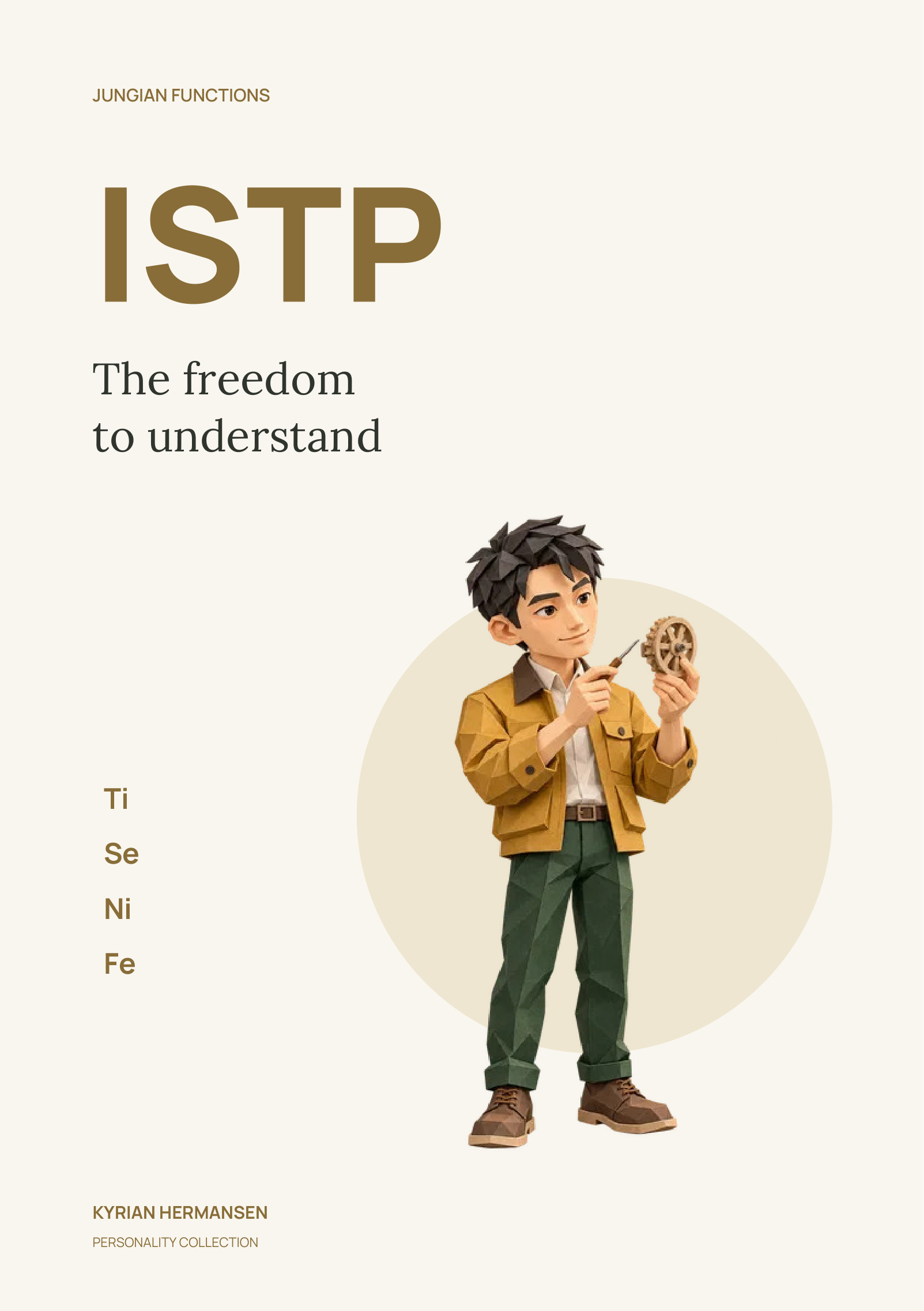
ISTP · KYRIAN HERMANSEN
The freedom to understand
An explanation can seem clear to everyone else and still leave you with a question. You want to see how it holds together, try it, and understand its limits. Sometimes people mistake your silence for disagreement when you are still thinking.
A 120-page illustrated book that explores the ISTP personality through Jungian functions and connects them to the decisions and relationships in your daily life.
US$18 · English edition
A5 PDF · One-time payment · No subscription
You recognize the four letters. What comes next?
ISTP descriptions often emphasize tools, independence, and composure. I think they can miss something essential: how understanding develops. You may enjoy ideas, books, precise conversations, or making things. For typing, I care about the reasons guiding your attention and decisions. Functions let us examine them without requiring you to play the person who fixes everything and says nothing. They also leave room for attachment, uncertainty, and enjoying an activity without optimizing it.
This book gives Ti, Se, Ni, and Fe time to make sense through a continuing story and ordinary situations. We examine understanding, trials, intuitions worth checking, and intentions worth explaining. You will find comparisons with INTP, ESTP, and ISFP, followed by four weeks of observation. I want to offer reference points for examining your choices without turning independence into an obligation to understand everything alone.
- Understand Ti through criteria, definitions, and the reasons supporting an explanation.
- Explore Se beyond stereotypes: observe, try, and recognize a result’s limits.
- Make room for Ni and Fe: examine an intuition and communicate an intention.
- Compare nearby types and revisit your own situations over four weeks, without scores.

Ti · Se · Ni · Fe
The functions have room to make sense
Each function gets its own chapter: an explanation, a place in an everyday scene, and questions to help you examine your own patterns.
Introverted Thinking
Check the reasoning
Extraverted Sensing
Meet the present situation
Introverted Intuition
Let a direction emerge
Extraverted Feeling
Attend to the exchange
Your path through the 120 pages
- 7–18
Where the framework comes from
Jung, his exchanges with Freud, and the later work of Briggs and Myers.
- 19–48
The letters and all eight functions
The foundations you need, without assuming you already know the vocabulary.
- 49–60
Meeting the ISTP profile
A nuanced portrait that leaves room for the parts you don’t identify with.
- 61–98
Exploring Ti, Se, Ni, Fe
Four chapters with fictional scenes, explanations, and practical exercises.
- 99–108
Connecting the ideas to daily life
Situations that connect the framework to decisions, conversations, and projects.
- 109–120
Observe, try, and return to your experience
A four-week observation plan, a glossary, and the book’s references.
Pages 7–48 introduce the shared foundations of the collection. The section focused specifically on ISTP begins on page 49.
Get a feel for the book before you decide
Noé prepares a folding display for a reading table with Amina and Gabriel. His first model stands, but some covers remain hidden. They need to clarify what matters, try it on site, and hear different uses. The characters and story are fictional. They illustrate perception and judgment questions; this book is not a construction manual.
The PDF preview contains 18 selected pages from the book. Open it without an account or email address, look through the layout, and see whether the explanations work for you.
Open the free preview →Digital book · English edition
Take a closer look with the ISTP book
This book gives Ti, Se, Ni, and Fe time to make sense through a continuing story and ordinary situations. We examine understanding, trials, intuitions worth checking, and intentions worth explaining. You will find comparisons with INTP, ESTP, and ISFP, followed by four weeks of observation. I want to offer reference points for examining your choices without turning independence into an obligation to understand everything alone.
120 illustrated pages · A5 PDF · One-time payment
US$18
Your download link is provided after payment. No physical book will be shipped. This purchase includes the English edition only.
Before you download
Do I need to be certain of my type?
No. Treat the descriptions as ideas to compare with your experience. If you’re unsure, start with the ISTP profile and the free preview.
What will I receive?
The 120-page illustrated PDF in English. It uses a fixed A5 layout, so you may need to zoom on a phone. This is not a reflowable EPUB or a printed book.
Do the website tests now cost money?
No. The questionnaires and their results remain free. The price applies only to this digital book.
Does the purchase include both languages?
Each language edition is sold separately. Choose the language you prefer to read; both editions follow the same underlying path.
Will this book establish my personality type?
It gives you ideas for examining your patterns. It does not certify a type or provide a diagnosis, and the exercises do not prescribe a result you must achieve.
Further reading: the Myers & Briggs Foundation introduction to type dynamics and processes
This is a typological framework. The function order shown is a common convention within this approach; schools differ in how they interpret development. This independent publication is not affiliated with the official MBTI® instrument. A type is neither a diagnosis nor a measure of your worth or abilities.